
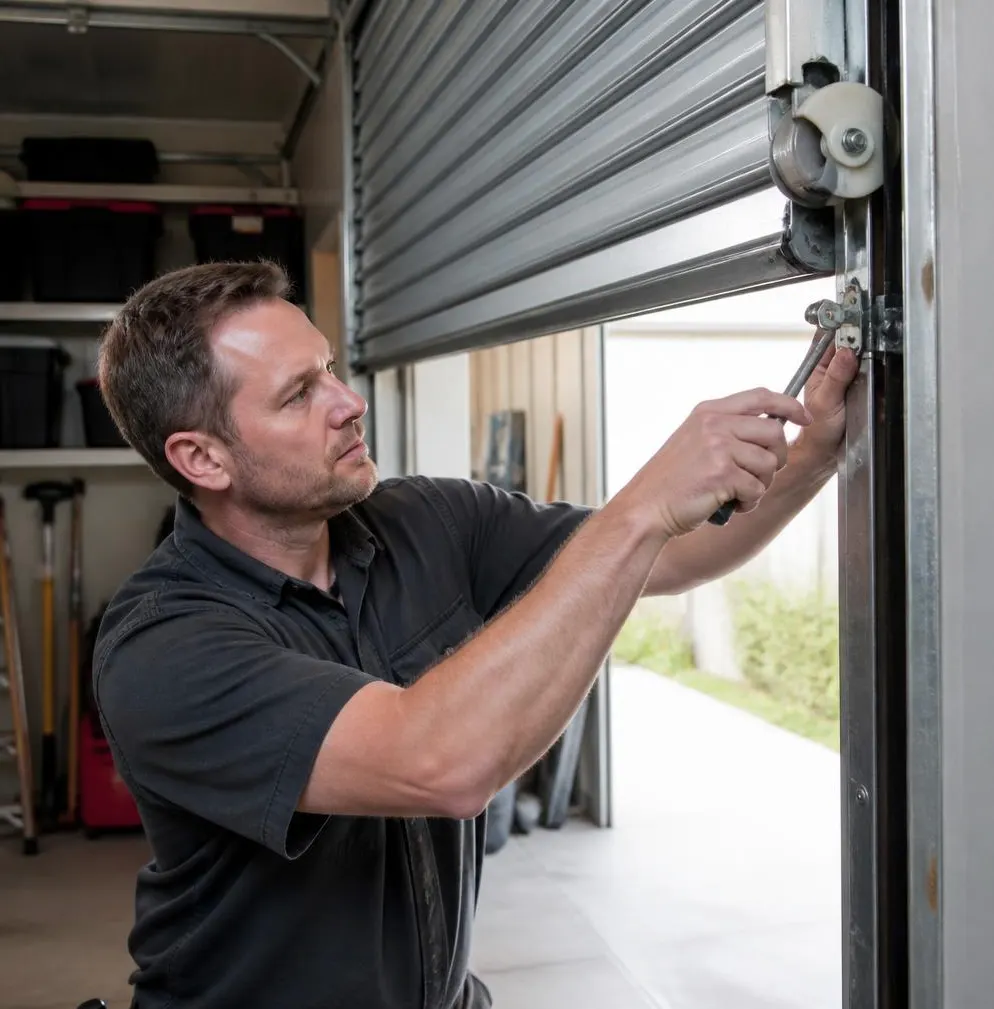
The first thing most people do when a garage door won't budge in the cold is grab a tool and start prying at the bottom, or mash the remote button over and over hoping the fourth try is the charm. It's tempting because the door looks stuck in one spot, like it just needs a firm push to break free. But forcing it usually bends the bottom panel, cracks the weatherstripping, or burns up the opener's motor trying to overcome resistance it was never built to fight. A door that's frozen or sluggish almost always has a specific, fixable cause, and finding it takes less effort than fighting it.
What a Frozen or Sluggish Door Actually Looks Like
Before getting into causes, it helps to know what you're seeing. The symptoms usually point to different problems:
- The door stops a few inches off the ground and won't go further, even though the opener motor is still running.
- You hear the opener chain or belt moving, but the door itself doesn't budge, a sign of slipping rather than freezing.
- There's a loud crack or pop when the door finally releases, followed by it moving normally.
- The bottom panel looks slightly bowed or pulled where it meets the slab.
- The door opens and closes in jerky, uneven steps instead of one smooth motion.
- It feels noticeably heavier than it did in warmer months, even by hand.
- After closing, there's a visible gap or the seal doesn't sit flush like it used to.
Each of these points toward a different part of the system, which is exactly how a technician approaches the problem: start with what's touching the ground, then work up through the hardware to the opener.
Working Through the Causes, in the Order a Technician Checks Them
1. Ice Bonding the Bottom Seal to the Slab
This is the most common culprit after a freeze-thaw cycle, which this area gets plenty of between late fall and early spring. Snow or slush melts during the day, runs under the door, and refreezes overnight, gluing the rubber weatherstripping to the concrete. The fix is simple but needs a light touch: warm, not boiling, water poured along the seal, or a plastic scraper worked gently underneath. Never use a metal pry bar or hammer here, it tears the seal and can dent the bottom panel. If this keeps happening, the weatherstripping itself may be stiff and cracked from age and needs replacing before it causes bigger problems.
2. Cold-Thickened Lubricant and Grime in the Tracks
Standard lubricant thickens in cold temperatures, and road salt tracked in on tires or boots mixes with old grease to form a gritty paste in the tracks and on the rollers. This adds drag the opener has to fight through, which shows up as jerky, uneven movement. A technician wipes down the tracks, checks the rollers for flat spots or cracking (nylon rollers get brittle with age and cold), and reapplies a silicone-based lubricant made for garage doors, not a general-purpose spray, which can attract more dust and grime.
3. Torsion Springs Losing Tension in the Cold
Steel contracts as temperatures drop, and torsion springs are no exception. A spring that was already near the end of its lifespan can lose enough tension in cold weather that the door feels dramatically heavier, or the opener strains and reverses before fully closing. This is also when a weak spring is most likely to snap outright, since the added strain of cold, stiff hardware pushes it past its limit. A technician checks the spring for visible gaps between coils, rust, or uneven winding, then runs a manual balance test with the opener disconnected. If the spring needs replacing, this is not a DIY repair. Torsion springs are under heavy tension and have caused serious injuries when handled without the right tools and training.
4. Opener Force Settings and Limit Switches Drifting
Plastic gears, chains, and belts also contract slightly in cold weather, which can throw off the opener's limit settings. The opener may think the door has hit the floor when it hasn't, or sense resistance that isn't really there and reverse mid-cycle. This is also where to check the safety sensors near the bottom of the tracks. They can fog up or get coated with condensation on humid winter mornings, which stops the door from closing at all. A technician adjusts the force and limit settings and cleans or realigns the sensors as needed.
5. Weak Batteries in the Remote or Keypad
Cold weather drains batteries faster, and a remote that worked fine in October can act sluggish or unresponsive by December. This is a quick, cheap check, but it's rarely the whole story if the door itself is also moving slowly or sticking at the bottom, so it's worth ruling out last rather than assuming it's the only issue.
When to Call Pacific Garage Door
If the ice problem keeps coming back no matter how carefully you clear it, if the door bangs or jumps during operation, or if you can see daylight through a gap in the spring coils, it's time to call. Our Garage Door Repair service covers everything from worn rollers and misaligned tracks to opener sensor issues, and our Spring Replacement service handles the parts of the job that genuinely aren't safe to tackle yourself. Given the swings in temperature this area sees from fall into spring, a pre-winter tune-up through our Garage Door Maintenance service can also catch a weak spring or a stiff roller before it turns into a 7 a.m. no-show on a freezing morning.
If your garage door is fighting you every cold morning, give Pacific Garage Door a call. We serve homes and businesses throughout Pacific, Eureka, Gray Summit, Union, Wildwood, Villa Ridge, St. Clair, and Washington, and we'll get your door moving the way it should before the next hard freeze sets in.